
From Mashable – While technology is often cited as a barrier to real human connection, it also unites people in a way that\’s changing communities and individual lives, as well as how we do business. And it\’s happening all over the country.
Workplace Learning in the Digital Age
Dr. Donna Murdoch
From Mashable – While technology is often cited as a barrier to real human connection, it also unites people in a way that\’s changing communities and individual lives, as well as how we do business. And it\’s happening all over the country.

From CNET – Microsoft Windows 1.0, seen here, was released in November 1985. Unfortunately for Microsoft, it failed to inspire — especially when compared with the more user-friendly graphical user interface developed by Apple for the Macintosh.

With tens of millions of dollars worth of support from all the bigwigs in tech, a new nonprofit called Code.org wants to bring computer science into schools.
Its first initiative will be a worldwide “Hour of Code” during the second week of December, with materials provided that include coding tutorials from Mark Zuckerberg and Bill Gates.
via Mark Zuckerberg and Bill Gates Teach Code.org Online Coding Class – Liz Gannes – News – AllThingsD.

From miniatures to medical equipment to meat, 3D printing is changing the way we produce everyday objects. With Out of Hand: Materializing the Postdigital, the first major exhibition to explore digital fabrication, 3D printing and other computer-assisted production finally get the highbrow treatment.
via The art of 3D printing (photos) — Tech News and Analysis.

Under a groundbreaking partnership between Twitter and Comcast, announced Wednesday, Fandango will be able to sell tickets directly from the social media platform.
The details on this new venture remain unclear for now — it’s early days as they like to say — but the potential is limitless. Can you imagine a movie studio or movie star using Twitter to sell tickets for a movie they are working on by tweeting about it?
via How Twitter Could Make Movie Studios a Boatload of Cash – TheWrap.
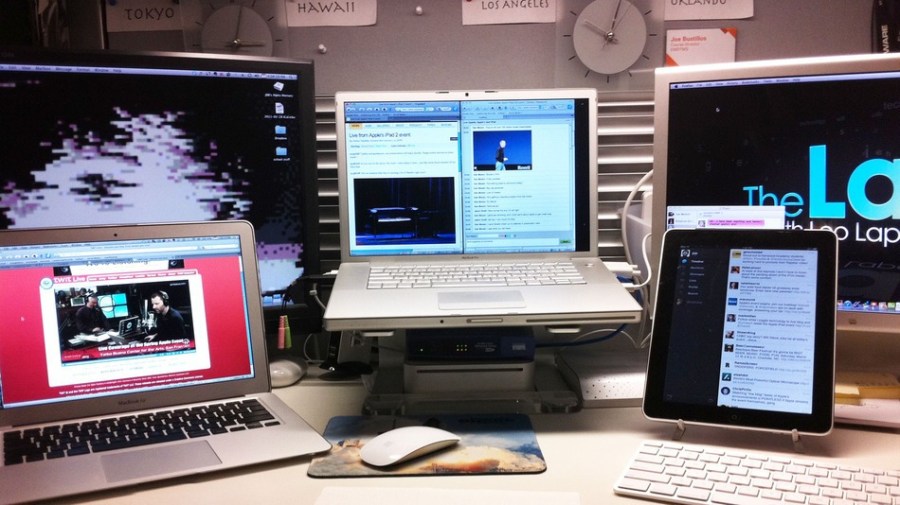
For many people, staring at screens is a simple daily occurrence: our jobs require use of a computer and many of us have smartphones that connect to the Internet. We often stop focusing on one screen just long enough to turn our attention to another.
But how much time do we really spend with our eyes transfixed on a digital display?

There are a lot of rumors and legends about Apple. Some are of course exaggerations and myths, and some are pure fabrication in order to make Apple sound even more mysterious and secretive. To some extent, Apple has been the driving force behind this since they have gone to great lengths to preserve the shock value of their product unveilings. There has been a lot of talk about where exactly the Apple name came from when they decided to name the company.
via Steve Jobs & Steve Wozniak On Why They Named Their Company Apple.

So obviously the internet is a super useful tool for finding new music. It\’s a super useful tool for finding new anything. But there are so many music discovery things out there between Pandora, iTunes Radio, and like 30 different features in Spotify alone. So what\’s your personal favorite way to find new tunes on the \’net? Is there one that\’s just the best?
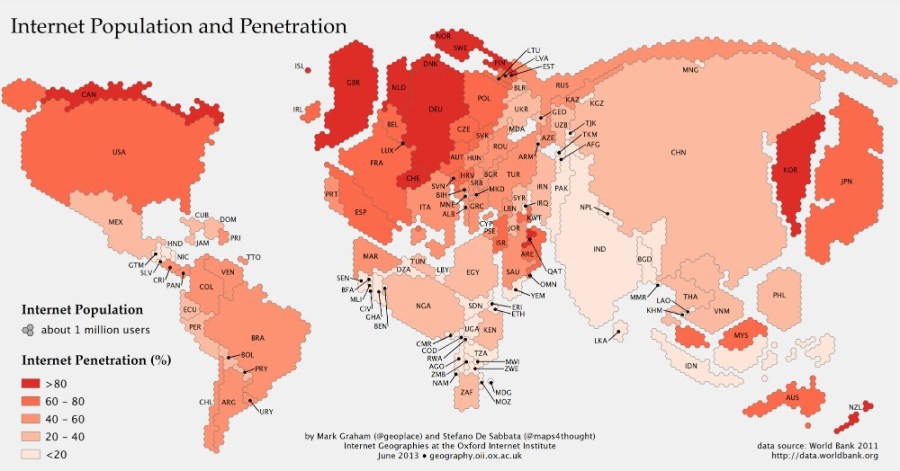
The map, created as part of the Information Geographies project at the Oxford Internet Institute, has two layers of information: the absolute size of the online population by country (rendered in geographical space) and the percent of the overall population that represents (rendered by color). Thus, Canada, with a relatively small number of people takes up little space, but is colored dark red, because more than 80 percent of people are online. China, by contrast, is huge, with more than half a billion people online, but relatively lightly shaded, since more than half the population is not online.
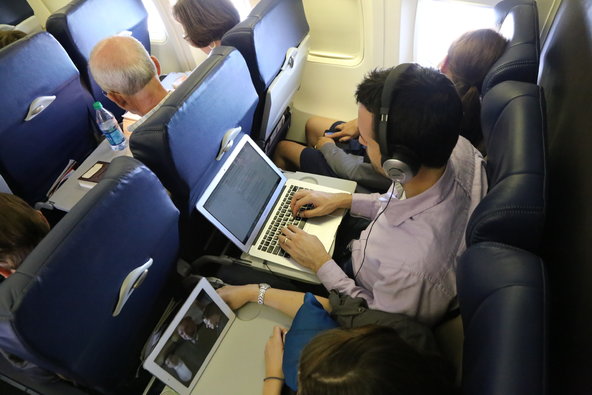
“If the F.A.A. doesn’t come out with a reasonably prompt timeline in the next 60 to 90 days, then I will go full bore to get this done legislatively,” she said.
With a report in hand that says devices cannot harm a plane, she said, it will be easy to push through legislation requiring the change.
via Disruptions: How the F.A.A., Finally, Caught Up to an Always-On Society – NYTimes.com.
 Workplace Learning in the Digital Age