Upgrade your brain: Programming resources for coding newbies

I’m not sure it is avoidable for anyone.  CEOs need to know the basics of coding, and there are so many ways to learn there are no excuses.  TNW shares some ideas.  The go so far as to call it a digital literacy.  “It used to be okay to just be a manager and leave the tech to the geeks, these days, products are being developed at speeds never seen before, sometimes in weeks. The rates of execution, iteration and experimentation (lean) are neck-breaking, and you should be a part of it, hands-on, and not as an orchestrator only.”

via Upgrade your brain: Programming resources for coding newbies – The Next Web.

Your Twitter Conversations Fall Into One of These Six Categories

A recent study from the Pew Foundation categorized Twitter conversations, putting different types of discussion into silos.  I think some of us fall into different categories at different times.  “Researchers concluded that there are roughly six different types of conversational archetypes that take place on Twitter. In other words, most conversations take the form of one of these six general structures: Polarized Crowd, Tight Crowd, Brand Clusters, Community Clusters, Broadcast Network, Support Network.”  From Mashable.

via Your Twitter Conversations Fall Into One of These Six Categories.

In Apple’s healthcare play, will BYOD = Bring Your Own Data?

The Quantified Self seems to be Apple’s newest direction.  It’s not really a surprise, as the newest iPhones have a chip that measure our steps and motion, even though few apps take advantage of it.  They’ve clearly been thinking about this for some time, and new reports are making the plans take shape.  “As we sifted through the reports and rumors, we became encouraged about the level of discourse about Apple’s possible healthcare play. Much of the discussion has centered around Apple’s assembly of a high caliber team of experts with deep experience in medical sensors and patient monitoring technologies, which gave further credence to reports of Apple’s possible introduction of an “iWatch” that would allow users to track health and fitness data generated by sensors embedded in the wearable. Some even raised the possibility that Apple might be interested in developing medical devices, peripherals or accessories for the iPhone.”

via In Apple’s healthcare play, will BYOD = Bring Your Own Data? | VentureBeat | Health | by Mark McAndrew, Taft Stettinius & Hollister LLP.

Why Pushing People to Code Will Widen the Gap Between Rich and Poor

Interesting opinion from Wired:  Nearly every part of our lives is influenced by code. It’s the infrastructure that makes our digital technologies operate — the software that’s changing our world in innumerable ways — and knowing how to code opens up a new world of opportunities. Some would even argue it’s a prerequisite in our increasingly algorithmic existence.

via Why Pushing People to Code Will Widen the Gap Between Rich and Poor | Wired Opinion | Wired.com.

The Hyphen in ‘E-Mail’ Just Lost a Major Ally

From Mashable – Still use a hyphen in the word email? Mashable does not, as you can see — and as of Monday, neither does the New York Times.

\”By popular demand, we\’re going to remove the hyphen from e-mail,\” declared the Grey Lady\’s editor of \”news presentation,\” Patrick LaForge, in a post on the newsroom\’s internal blog. He later confirmed the news in a tweet, along with some other tech word style changes:

via The Hyphen in ‘E-Mail’ Just Lost a Major Ally.

What the World Would Look Like If Countries Were As Big As Their Online Populations

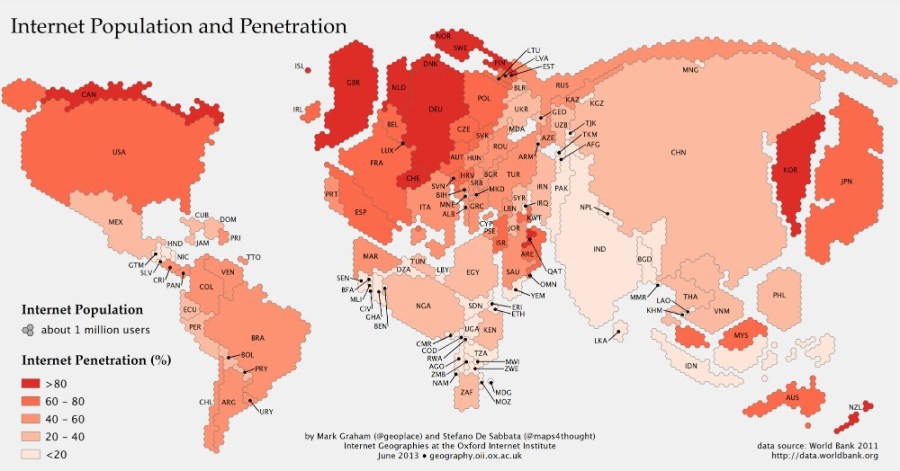
The map, created as part of the Information Geographies project at the Oxford Internet Institute, has two layers of information: the absolute size of the online population by country (rendered in geographical space) and the percent of the overall population that represents (rendered by color). Thus, Canada, with a relatively small number of people takes up little space, but is colored dark red, because more than 80 percent of people are online. China, by contrast, is huge, with more than half a billion people online, but relatively lightly shaded, since more than half the population is not online.

via What the World Would Look Like If Countries Were As Big As Their Online Populations – Rebecca J. Rosen – The Atlantic.

Why Google Reader Really Got the Axe

“As a culture we have moved into a realm where consumption of news is a near-constant process” says Richard Gingras, Senior Director, News & Social Products at Google.  “Users with smartphones and tablets are consuming news in bits and bites throughout the course of the day – replacing the old standard behaviors of news consumption over breakfast along with a leisurely read at the end of the day.”   Well, I am still wondering what I will do when it’s gone next month, but here is the article on Wired that tells a new story about why…..